


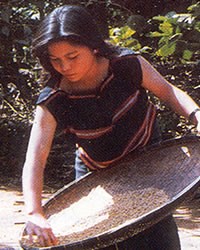

The Southern Roglai, also known as Raglai or Rac Lay, live primarily in the south central provinces of Ninh Thu-n, Khánh Hòa, and Bình Thu-n in Vietnam. They belong to the Chamic branch of the Austronesian language family, and their language reflects deep historical ties to the Cham people while maintaining its own distinct identity. Their communities occupy mountainous and forested regions, where they continue to rely on the land for their livelihood and cultural traditions. Their name "Raglai" derives from their word for 'forest,' reflecting their traditional mountain habitat.
The Roglai trace their origins to ancient Austronesian migrations that settled along Vietnam's central coast and highlands. Over centuries, they developed a unique culture shaped by their environment, their relationship with the Cham, and their relative isolation in the highlands. They traditionally lived in small villages, practiced swidden agriculture, and depended on forest resources for survival. Colonial rule and the conflicts of the twentieth century disrupted their communities and forced many Roglai to relocate. After the Vietnam War, government resettlement programs and economic development projects further altered their traditional lands and ways of life. Today, the Roglai continue to balance the preservation of their heritage with the pressures of modernization.
Most Southern Roglai support themselves through subsistence farming. They grow rice, maize, cassava, and vegetables, and they raise livestock such as pigs and chickens. Many families also gather forest products like bamboo, honey, and medicinal plants to supplement their income. Although infrastructure has improved in recent years, many Roglai villages still face limited access to healthcare, education, and clean water.
Roglai villages typically center around extended families, and elders play an important role in guiding community decisions and leading traditional ceremonies. While some families still build houses on stilts, many now construct ground level homes using modern materials. The Roglai language remains central to daily life, but many adults struggle with Vietnamese, which creates challenges in education and government interaction. Children often face barriers in school due to language differences and economic pressures that pull them into farm work.
They primarily believe in an animistic and polytheistic ethnic worldview (nearly ¾ of Southern Ronglai) centered on a spiritual world of gods and spirits ("Giang" as the supreme deity or universe god) inhabiting nature—mountains, rivers, trees, animals—and ancestors. They believe spirits can help or harm, requiring sacrifices, prayers, and shaman-led ceremonies to maintain harmony and seek blessings. They worship wooden ancestor statues (unlike the Cham, who largely abandoned idols). In the 20th century, many converted to Christianity, with now more than a quarter being Christian adherents overall (and nearly half of those being evangelicals). This qualifies them as "engaged yet unreached" or "significantly reached" in some assessments, with New Testament scriptures available in their language.
Needs include spiritual growth amid syncretism and preservation of their endangered language and cultural heritage amid modernization/Vietnam's development pressures. They also need improved access to education/healthcare in remote areas, economic opportunities beyond subsistence farming, and protection from historical discrimination as an ethnic minority.
Pray that the Southern Roglai would encounter the true God through the available New Testament in their language and that existing believers would grow in faith and share the gospel boldly with others, even those in Buddhist communities.
Pray for protection and unity among Southern Roglai Christians, that they would live out their faith in a way that honors both biblical truth and their cultural heritage without compromise.
Ask the Holy Spirit to move powerfully in Southern Roglai villages, breaking strongholds of fear related to spirits and ancestors, and bringing freedom and healing.
Pray for more laborers and resources to disciple new believers, establish healthy churches, and translate additional Scriptures or audio teachings into Southern Roglai.
Scripture Prayers for the Roglai, Southern in Vietnam.
https://en.wikipedia.org/wiki/Roglai_language (en.wikipedia.org in Bing)
Southern Roglai – PeopleGroups.org https://peoplegroups.org/explore/GroupDetails.aspx-peid=511225
Southern Raglai Corpus – Pangloss Collection (CNRS) https://pangloss.cnrs.fr/corpus/Southern_Raglai
Southern Roglai Language – Ethnologue https://www.ethnologue.com/language/rgs
| Profile Source: Joshua Project |



